
The Silent Disease: What Everyone Should Know About Osteoporosis and Bone Health
- InnerSight AI
- Jul 6
- 9 min read
There's a reason osteoporosis has earned the nickname "the silent disease." Unlike high blood pressure or high cholesterol, it doesn't show up on a routine check-up unless you go looking for it. Most people find out they have it the hard way - by breaking a bone. And for a disease this common, that's a serious problem, because a hip fracture later in life isn't just an inconvenience. It can be the beginning of the end.
In Episode 30 of the Innersight Podcast, we sit down with Dr. Marius Roos, a physician who has spent over a decade specializing in bone health, to unpack what osteoporosis actually is, who should be screened, and most importantly, what you can actually do about it.
Why hip fractures are such a big deal
Before getting into the science, it's worth understanding why this conversation matters so much. Someone who suffers an osteoporotic hip fracture has roughly a one-in-three chance of dying within three years of the fracture. Of those who survive, about half never return to their previous baseline of function. Basic daily activities such as walking, dressing or cooking, can become permanently harder. That statistic alone is why catching bone loss early, long before a fracture happens, matters so much.
Bone is not just scaffolding
One of the most interesting reframes in the conversation is about what bone actually is. It's tempting to think of your skeleton as something static - sticks and bricks holding the rest of you together. In reality, bone is living tissue that's metabolically active every day of your life.
Roughly 60% of bone is inorganic mineral, the "cement" that gives it strength. The remaining 40% is organic material, mostly collagen, along with living cells that continuously build bone up and break it down. That process of renewal never stops.
What's more, bone doesn't operate in isolation. It's in constant conversation with the rest of the body - with muscle, with the immune system and with metabolism. Muscle cells release signalling proteins called myokines that talk to bone, and bone releases its own signals (like osteocalcin) that influence insulin sensitivity and cardiovascular health. This growing field, sometimes called osteoimmunology, is reshaping how doctors think about bone: not as a passive structure, but as an organ with its own hormonal reach.
So what exactly is osteoporosis?
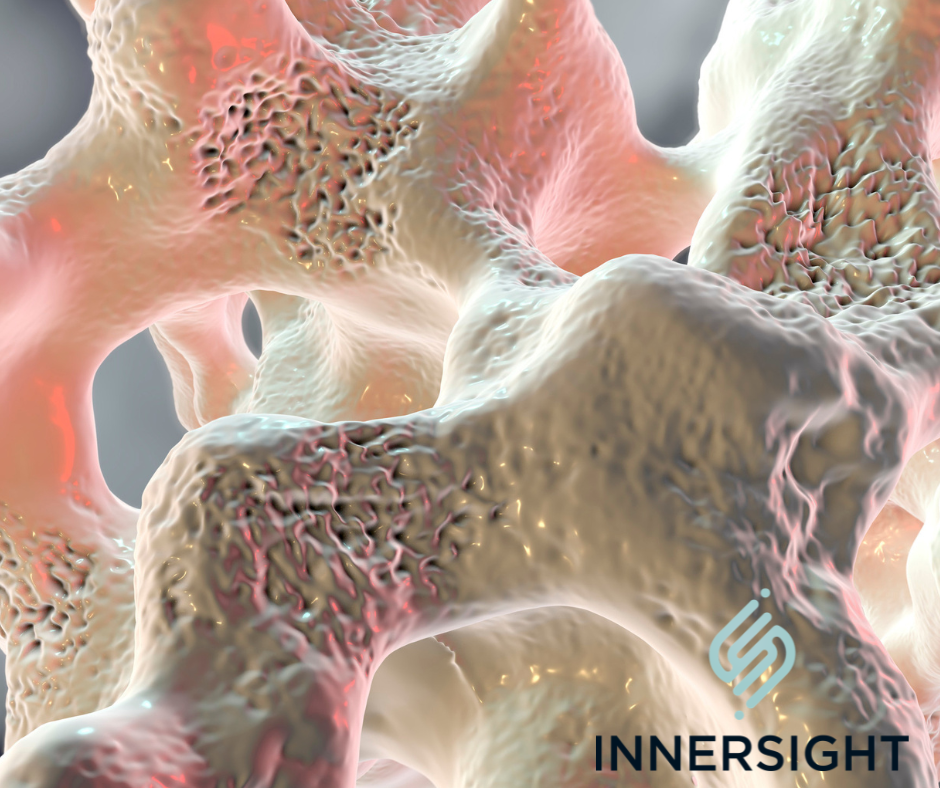
The formal definition, first published in 1993, describes osteoporosis as a chronic, systemic skeletal condition marked by two things: a loss of bone mass, and a deterioration of bone's internal microarchitecture. Together, these reduce bone strength and increase the risk of fragility fractures - breaks that happen under forces that shouldn't normally break a healthy bone. Put simply, osteoporosis is a loss of bone strength that leaves you vulnerable to breaking a bone from something as ordinary as a stumble or a minor fall.
The bone bank account
Bone mass follows a predictable arc across a lifetime. You build it throughout childhood and adolescence, and typically reach your peak bone mass somewhere between ages 20 and 30. From there, bone mass tends to stay relatively stable until about age 50. After that, men experience a slow, gradual decline but women experience something more abrupt: a rapid drop in bone mineral density around menopause, driven by the loss of estrogen.
Dr. Roos used a helpful analogy: think of bone like a bank account. If you build up a healthy reserve early and look after it, that reserve keeps compounding in your favour. But if you don't, it behaves more like debt, declining quickly once the balance tips the wrong way.
This is exactly why the conversation shouldn't start at 50 or 65. It should start decades earlier. The window between the late teens and around age 30 is when peak bone mass is built and whatever you accumulate in that window is largely what you'll be living off for the rest of your life. Encouraging kids and young adults to stay active isn't just about fitness today; it's an investment in the skeleton they'll have at 70.
Who actually needs to be screened?
The guidelines are fairly clear-cut:
Age 65 and older (men and women): screening is recommended for everyone.
Age 50–65: screening is recommended if you have additional risk factors.
Under 50: screening is generally reserved for people with a significant risk factor for secondary bone loss, or anyone who has already experienced a fragility fracture, since interpreting bone density scans in younger adults is less well established.
So what counts as a risk factor in that 50–65 window? Dr. Roos listed several worth knowing:
Family history of osteoporosis or fractures - genetics play a major role.
Metabolic conditions, particularly type 1 and type 2 diabetes.
Autoimmune diseases, especially rheumatoid arthritis.
Neurological conditions such as Parkinson's disease or reduced mobility following a stroke.
Inflammatory gut conditions, including inflammatory bowel disease, coeliac disease and other malabsorption disorders.
Vegan or vegetarian diets, which can leave important nutritional gaps relevant to bone health if not carefully managed.
Certain medications, including long-term proton pump inhibitors (antacids), SSRIs, and chronic opioid use.
A history of falls, for any reason including something as simple as a bicycle spill.
If you tick even a couple of these boxes, it may be worth having the conversation with your doctor well before 65.
What a DEXA scan actually involves
The standard test for bone density is a DEXA scan (dual-energy X-ray absorptiometry). It's a straightforward, non-invasive test: you lie on a bed while a low-dose X-ray source beneath you and a receiver above you measure how radiation passes through both bone and soft tissue. The difference in transmission is used to calculate bone mineral density.
The radiation dose is remarkably small, roughly a hundredth of a standard chest X-ray and comparable to about one three-thousandth of the natural background radiation most people receive over a year just living at sea level. It's also inexpensive relative to many other diagnostic tests, which makes it an accessible starting point for anyone concerned about their bone health.
Results are usually reported as a T-score, which compares your bone density to that of a healthy young adult (the reference range is based on a healthy 20–30-year-old, and is used for both men and women). A T-score of zero represents that healthy baseline; as bone density falls, the score becomes increasingly negative. A T-score of -2.5 or below meets the World Health Organization's definition of osteoporosis. Scores between 0 and -2.5 fall into a lower bone mass category often referred to as osteopenia, signalling a trend worth watching and acting on before it progresses further.
Follow-up frequency after a normal scan depends on your individual risk profile: roughly every 3-5 years for people with no additional risk factors, and closer to every 1-2 years for those with significant risk factors.
Beyond the T-score: thinking in terms of fracture risk
One of the more important shifts in the field, according to Dr. Roos, has been a move away from looking at a bone density number in isolation, and toward a broader risk-stratification approach, not unlike how cardiovascular risk is now assessed using more than just an LDL cholesterol number.
The key tool here is the FRAX score, a free online calculator that estimates your 10-year probability of a major fracture based on clinical risk factors, with or without an actual bone density value. This makes it an accessible first step, even before someone gets a scan, and it's increasingly being used to decide who should be prioritized for a DEXA scan in the first place.
Based on FRAX results, bone density and clinical history (such as a T-score of -3 or lower, or a history of multiple fragility fractures), patients are generally grouped into low, high or very high fracture-risk categories, each guiding a different level of intervention.
The good news: bone loss can be reversed
Perhaps the most encouraging point in the whole conversation: bone density isn't a one-way street. Dr. Roos has seen phenomenal improvements in patients who commit to the right interventions, and osteoporosis, once thought of as a grim, fixed diagnosis, is increasingly something that can be actively managed and even meaningfully reversed.
To organize his approach, Dr. Roos uses a pyramid model, built from the ground up:
Lifestyle foundation: diet, exercise, sleep, recovery, purpose and relationships.
Training and conditioning: the specific stimulus needed to trigger bone-building.
Supplements and nutraceuticals: filling nutritional gaps where diet falls short.
Hormone optimization: addressing estrogen, testosterone, thyroid, insulin and cortisol.
Pharmaceuticals: medication, sitting at the apex, most effective when built on a solid foundation beneath it.
The core message: medication works best, and with the fewest downsides, when it's supported by everything underneath it, not used as a substitute for it.
Diet: calcium and vitamin D
Calcium deficiency is far more common than most people assume. Dairy remains, by a wide margin, the most reliable and bioavailable source: an egg contains only around 40 mg of calcium (you'd need roughly 50 a day to hit a 1,000-1,200 mg target), while a single glass of milk provides around 300 mg. If dairy isn't part of your diet, it's worth actually calculating your intake, since it's easy to fall short without realizing it. A dietitian can help pinpoint gaps and decide whether supplementation makes sense for your situation.
Vitamin D deficiency, meanwhile, is strikingly widespread - in the clinic's own screening, almost no one comes back with a normal level. Calcium and vitamin D work together, and the evidence is clear that calcium alone doesn't move the needle on fracture risk, while the combination does. Rather than blanket supplementation, the recommended approach is to test your actual level, then optimize through diet, sensible sun exposure and supplementation only where needed.
Exercise: it's not just about walking
Perhaps the most actionable and most under-appreciated point in the entire conversation: walking and cardio alone are not enough for bone health. What bone actually needs is weight-bearing impact and resistance training - activity that puts real mechanical tension through the bone via the tendons, stimulating the cells responsible for building new bone.
Not all impact is equal either. Walking counts as low impact; running and jumping rank higher, with a genuine dose-response relationship - generally, more mechanical load means more benefit.
Resistance training (using weights, bands, or bodyweight) sits in its own category and is described as a genuine "game-changer" for both muscle and bone.
A useful rule of thumb from the conversation: aim for roughly two-thirds resistance training to one-third cardio. And crucially, this isn't just for the young. A landmark Australian study (LIFTMOR, led by Dr. Belinda Beck) demonstrated that even elderly women can safely undertake heavy resistance training, with striking gains in bone strength. The body's capacity to adapt to load doesn't disappear with age nearly as much as most people assume.
Sleep and hormones
Sleep made it into the foundational layer of the pyramid for good reason, even though direct research linking sleep specifically to bone density is still limited. Poor sleep and sleep apnea are known to suppress testosterone production, and testosterone plays a role in stimulating bone health - one of several plausible pathways (alongside inflammation, oxidative stress and growth hormone regulation) through which sleep likely supports bone.
Hormones, more broadly estrogen, testosterone, thyroid, insulin and cortisol, all play a role in bone metabolism. Estrogen in particular is a major factor for women, and Dr. Roos emphasized the importance of considering menopausal hormone therapy as part of a bone-health conversation, especially given how much unnecessary hesitation around HRT still lingers from the fallout of the Women's Health Initiative study years ago.
Medication: sequencing matters
When lifestyle measures aren't enough on their own, several medication classes are available, broadly split into anti-resorptive options (which slow bone breakdown, including hormone therapies, bisphosphonates and denosumab) and anabolic options (which actively build new bone, including teriparatide and the newer romosozumab).
An important nuance here: most of these medications have a limited window during which they can be safely and effectively used before the benefit-to-risk balance shifts. That means treatment isn't simply "start a drug and stay on it forever" - it requires thoughtful sequencing over the course of a patient's life, planned well in advance rather than reactively.
The window that matters most
If there's one theme that runs through the whole conversation, it's timing. The years between roughly 35 and 50 are often the busiest of people's lives - careers, children, responsibilities, and consequently the years people are most likely to neglect their own health. But this window is precisely when action has the most leverage, both for bone and for other long-term health markers like cholesterol and blood sugar.
Dr. Roos's own experience is a good illustration. Despite having lived an active, healthy life, a routine bone density scan in his early 50s revealed his hip T-scores were already in the "low bone mass" range, a wake-up call that reshaped how seriously he took his own bone health, even as a specialist in the field.
The takeaway
If you remember only one thing from all of this, let it be Dr. Roos's closing point: your bone and muscle system isn't a passive backdrop to your health, it's a central, foundational organ system in its own right, with real influence over your metabolic, hormonal and long-term health.
The path forward doesn't require anything exotic. It requires the basics, applied consistently and early: enough dietary calcium, a vitamin D level worth knowing, resistance training alongside your cardio, decent sleep, and if you're over 50 with any of the risk factors above, or over 65 regardless, a bone density scan to know where you actually stand.
Osteoporosis earns its reputation as a silent disease because it gives so few warnings. The good news is that it also responds well to attention, and the earlier that attention starts, the more of that "bone bank account" you'll have to draw on later in life.
Watch this episode on our Youtube channel: https://youtu.be/j-r9wXYwlbM
If you would like to get in touch with Dr. Roos, you can contact him through the following website: 🔗 https://mariusroos.co.za/
#BoneHealth #Osteoporosis #HealthyBones #BoneDensity #MobilityMatters #HealthyAging #FunctionalMedicine #Longevity #StrengthTraining #ResistanceTraining #WeightBearingExercise #FracturePrevention #VitaminD #Calcium #GutHealth #HormoneHealth #AntiInflammatory #InnerSight
This blog post is only intended for general informational purposes. It is not a substitute for personalized medical advice. Please speak with your healthcare provider about your individual bone health and risk factors.


Comments